

Ink and fire
February marginalia: my notes on "The Book Thief" and "Archive Fever"
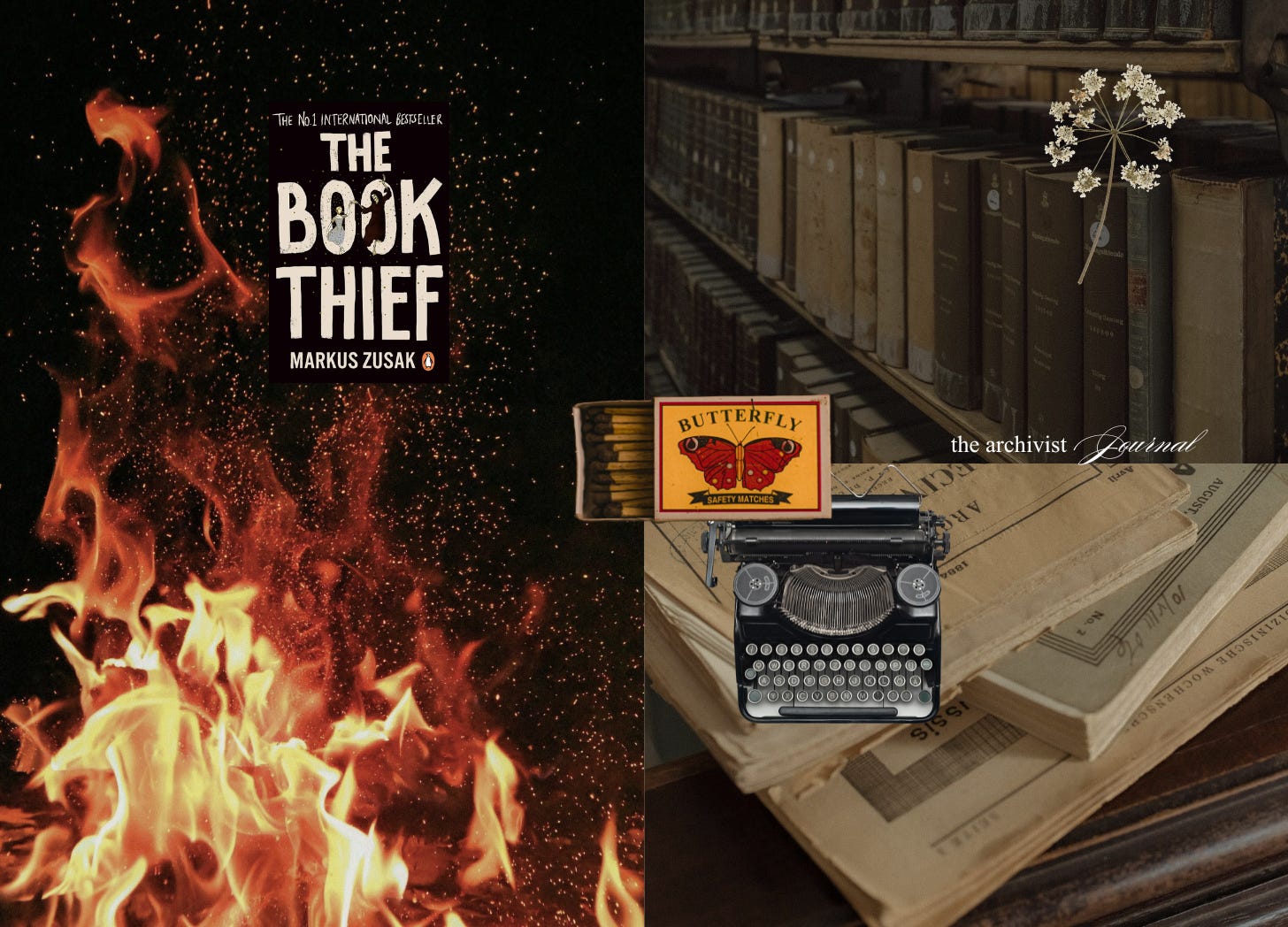
In between finishing my exams and starting the new semester, I was able (somehow) to read two books in February:
“The Book Thief” by Markus Zusak, published in 2005, tells the story of a german girl who steals books during the second World War;
“Archive Fever: a Freudian Impression” by Jacques Derrida, an essay published in 1996 and based on a lecture the french philosopher gave at a conference (Memory: The Question of the Archives) the year before.
Initially I wanted to speak about these books separately and write two different reviews, but I found they have so much in common that I prefer merging my marginalia into a single piece.
Ink is the first element that seems to link these very different books together, first of all because they’re both books, so they both needed to be written with ink on paper, and second because they both seem works of metaliterature. Literature talks about itself more specifically in Zusak’s book, but also Derrida’s essay about archives is itself an archival record. Ink and paper are means for remembering the story of a girl during the second World War and a philosopher’s speech at a conference.
So, memory is the puzzle piece that holds together Liesel’s story and Derrida’s philosophy. The last writes:
“The archive is hypomnestic1.”
Through the study of Freud’s theories, memory is divided in two different types: the first one, the natural memory, the one that happens every single time we make the effort and succeed in remembering something is called mneme; the second one, the prosthesis of human memory, the archival and artificial trick we invented because natural memory is fallible is called hypomnesis. So the archive is not a natural way to preserve memory, it “constantly works against itself” because it kills the living memory. Once something is stored in a record, there’s no need to remember it. The archive is born from the death drive, the pull towards destruction in psychoanalysis. We can only preserve what’s already dead: archive records are all corpses of the memories once living in our minds. Death narrates Liesel’s story in “The Book Thief”, because her written memory, the book it reads from, it’s the record of the life she’s no longer living. And books are alive only as long as they’re read, interpreted, thought of and remembered.
Liesel’s action of stealing books, particularly the one she steals from the fire (the Bücherverbrennung) is both revolutionary and conservative at the same time, just like the making of an archive. The girl saves the book from burning, from disappearing completely and being deleted from memory, but during the historical period she’s living, preserving memory and tradition (in a broad sense) is a form of rebellion against power. And “there’s no power without the control of the archive, if not of memory”. Derrida traces back the word “archive” to the ancient greek archeion, the “home” of magistrates (the archons), the ones who governed, and of the citizens, who made or represented the law. The written word is an instrument of power, especially when it ensures the survival of memory.
The second element that ties together the freudian impression and the Bücherverbrennungen is fire. Fire emerges in both books as a symptom of illness, the sickness of memory. At a certain point, people have realised that they can forget, so they started writing to remember. At the same time, probably, they also realised that they can make others forget, so they started burning books. It’s easy to read Zusak’s work though the lens of psychoanalysis, using the death drive as a means of interpretation. After all, death is everywhere in Nazi Germany: the first thing we witness is Liesel’s brother dying on a train, Death itself tells us this story. The burning of books it’s a symptom of a severe illness, deep rooted in history and human psychology.
Burning is concealing, destroying the proof that something happened, that something existed, lived. Derrida says that archival preservation destroys memory, because it lifts the burden of remembering from our minds and wonders at the end of the essay “what could’ve burnt in this archive fever”. But burning the files won’t help retrieving the living memories from our subconscious, and I think Liesel understood this.
According to the french philosopher, archeology and archives are inextricably interwoven, both share the same etymology in the word arché, the “beginning” (and the “power”). He says:
“The archaeologist achieved their goal to make the archive useless. It deletes itself, becomes transparent and additional to leave the origin (the beginning, the arché) introducing itself on its own.”
He says the archaeologist “makes the stones speak”, the living memory, so there’s no need to store their words in an archive anymore. But, as a former archaeology bachelor, I can’t help but think of everything that disappears in the layers of time: all the footsteps that don’t echo on a roman street, all the voices that don’t permeate from a temple’s walls, all the stories that lie buried under the soil wounded by bombs. Liesel knew that writing her story she was killing herself and everyone she talked about, but she understood that a trace, a record often lives longer than a human being, so long even Death couldn’t take it away.
Thanks for reading,
𝒢. 𝒢.
Feb 27 - Mar 6 2026 | digital garden
Media I recommend this week
27.02 Gifted: A haunting short story about a talentless girl with a gifted roommate (I'm trying to read more short stories lately).
28.02 I'm thinking of ending things (2020): A girl visits her boyfriend’s parents during a snowstorm. A strange and absurd film (unfortunately, I didn’t like this one, I felt like it didn’t speak to me at all).
3.03 The Blinkered Flâneur. Walking with Franz Hessel in 1920s Berlin: An analysis of Hessel's book "Spazieren in Berlin" and the implications of being non-political as a writer.
5.03 The Beautiful and the Inconvenient: How conveniency sometimes destroys rituals and beauty.
music: I usually don’t include it in my digital garden, but I’ve been loving the song regen by the german artist maia:
Related posts
People as deserts, deserts as archives

Cities built on medieval structures are usually easily recognisable: streets are paved with stones, which surface smoothed with time and now it makes the rubber soles of modern shoes slip; and the sidewalks are cramped, claustrophobic. Dragging suitcases in between the walls of the buildings on one side, and the parked cars on the other is a real strugg…
Studying paleography in the digital age

Sitting in a cold room, on the third floor of a palace built in the 1600s, with the evening sunlight streaming through the window, is the perfect way to learn the alphabet as an adult. My university teacher traces the letters one after the other, stopping every time to highlight with a red marker the direction of each line. There was a rigid method to w…
My Pinterest
I’ve read both books in italian translation, so the english translation in this text is mine. Parentheses and italics are my additions.
The Book Thief is one of my all time favorite books!! I may have to read it again.
Very interesting, thank you! You've encouraged me to read The Book Thief—because I have to admit that the cover of the Italian edition (and not just this book; Italian book covers in general seem to be getting worse and worse) is so kitschy that I would never have picked it up based on looks alone.