

My journal ecosystem
My analog organisation and memory keeping system

Keepers of private notebooks are a different breed altogether, lonely and resistant rearrangers of things, anxious malcontents, children afflicted apparently at birth with some presentiment of loss.
Joan Didion, On keeping a notebook (in Slouching towards Bethlehem, 1969)
I remember very clearly the first time I bought a journal at an amusement park, while on a school trip. My eyes landed on an A5 lined notebook with a fuzzy, light blue cover on which two dolphins, the park’s mascots, were embroidered. I was ten years old. I brought it home and wrote my name on the first page, then filled the rest in a couple of years mostly with stickers and scribbles. My first journal wasn’t just a childish purchase but the start of a long personal tradition of note taking and memory keeping. In this post, I want to share my current journal and notebook collection and how my journaling method evolved over the years.
My personal journal: my life as an epistolary novel
That notebook with the fuzzy cover is still in a box in my closet, together with a stack of all the journals I’ve filled up over the years with details of my personal life. The first few of them don’t contain much writing: my favourite way to use notebooks at the time was to stick cut out images of characters from my favourite TV series, note down some tongue twisters that were popular at school, and record the details of the most important school dramas (fights between friends, childish “relationships” ends and starts). Around the age of thirteen, I’ve started to actually write in my journals: the notebooks I’ve filled during that period of my life are letters containing reports of everyday events, my feelings, my questions. I was writing to a silent recipient, an invisible friend who always read but never answered, whose personality and looks (because it’s hard to spill your feelings on someone you can’t clearly picture in your head) I had borrowed from a book series I had been obsessed with as a kid. The more I grew up, the more I felt the need to journal to discover myself, even though now I’m not sure that’s the right approach to self awareness. In high school I’ve started using journal prompts and even writing in my second language as a way to keep my innermost thoughts safe from nosey people. Today, I write in my third language, more for learning purposes than for the sake of secrecy.
Journaling methods
I really hope that, by telling you about my journaling experience, I’ve inspired you to keep a notebook on your bedside table. Journaling has become a trend in the last few years and I’m happy a lot more people have started to record their life and reflect on their feelings: writing has always been a form of learning and therapy for me.
Throughout the years I’ve tried a few different journaling methods, these are the ones I currently use:
Stream of consciousness: this is still my favourite and most used one, it consists in just writing down whatever crosses my mind, without caring about grammar mistakes or coherence. It’s perfect for when I need to clear my head during a busy time or vent after a difficult situation.
Journal prompts: sometimes, when I have no idea what to write about, I open Pinterest and look for personal questions I feel safe to answer to in my journal (e.g. What makes you happy? What negative emotions and beliefs hold you back the most? etc.). It’s an easy way to get inspired when I have no motivation to write.
Creative journaling: I honestly made up this term, because I’m not sure how to call this method. “Creative journaling” also involves the use of prompts to write, but they are less personal than the ones I use for reflection. Often I find myself using poetry prompts (that I also find on Pinterest) and I write my thoughts in a stream of consciousness form. This works well for me when I feel blocked in my writing or creative process and need some time to create with no pressure for coherence or style.
My commonplace book: my life in an archive
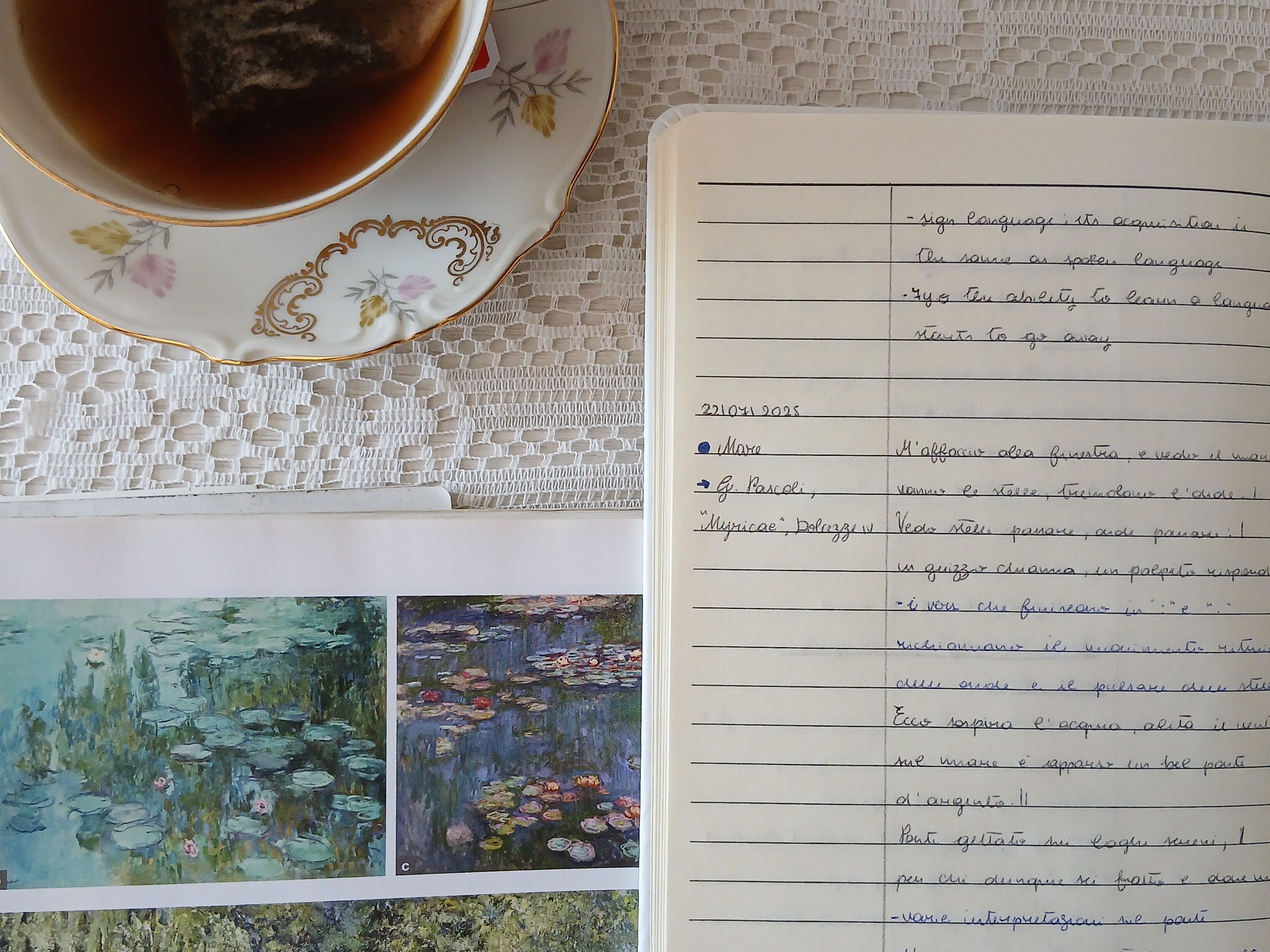
I’ve briefly talked about my commonplace book in a recent post where I also added some links to videos and resources on the history of commonplacing and how to start this habit. For me, a commonplace book is an interest-tracking tool, a notebook where I collect pieces of knowledge about things I’m interested in. My system is pretty simple and I’ve adapted it to my needs from more expert “commonplacers”1 who I’ve learnt from.
The first page of my commonplace book contains the key, a color coding system in which I organise the different subjects (e.g. blue for poetry, sage green for uni related info, red for language learning, and so on). The other pages are divided in two by a four centimeters margin: on the left I write the date of the entry, I draw a dot the colour of the subject the entry is related to and I write my source after an arrow (this could be a website name, a book title etc.); on the right, I write my entry in bullet points:
is for major sections
- is for informations related to the major sections
→ or > is for additional info, references etc.
Sometimes I use the margin to note down vocabulary, especially if what I’m reading is written in a foreign language, or draw diagrams and similar.


My reading journal: my life through strangers’ stories
A recent addition to my collection is my reading journal. I’ve always kept a reading journal more or less, but I used to only note down the title of the book I was reading, the star rating and my final thoughts. This year I’ve started using it for annotations. Since a lot of the books I read are e-books and I don’t like writing too much on physical copies (I wish I could annotate in the margins like the authors of the pictures I save on my Pinterest, but unfortunately most of the time I attempt to, I just make a mess), I just use a separate notebook.
When I start a new book, I write the title and author at the top of the page. The first section is dedicated to research and basic informations:
□ is for date of publishing
n) is for number of pages
△ is for date I’ve finished reading the book
✩ is for star rating
My annotation system is very similar to the one I use for my commonplace book:
● is for quotes
- is for my personal thoughts on the quote (e.g. if I agree/ disagree with a statement, if I like/ don’t like the behaviour of a character, reference to another book, and sometimes is just “lol” if a section made me laugh, it’s not always serious annotation)
○ is for vocabulary
(I’m currently updating my annotating system, so I’ll probably make another post about this)
Since I usually read classics, the stars I give to a book are not a rating of the book itself, but rather of my experience while reading it. Most times, when I give a low rating to a book, I end up rereading it, years later. I’m convinced some books will just never resonate with me, no matter how many times I reread them, but sometimes, in order to connect to a text, I just need to wait some time and experience particular things. And I don’t even consider the books that never end up resonating with me bad books, because art is subjective: classics are undoubtedly well-written, otherwise they wouldn’t be classics, but reading is an active interaction with a text, a conversation between the story and the reader; so even if I don’t particularly appreciate a book, I still recognise its value.
Here’s how my star rating works more or less:
1 ✩ I don’t remember ever giving this low of a rating, but if I did it would be because I was confused about the plot, didn’t like the writing style and overall I was completely disappointed.
2 ✩ I only remember giving this once last year to a recently published book I was gifted. This is for when I like the concept but not the execution, I found the plot unclear and the writing didn’t make up for it.
3 ✩ This is the lowest rating I give usually, I use it for books that I’ve appreciated but not entirely connected to/ understood. These are the books that I want to reread in a few years and see if I change my mind about them.
4 ✩ This is for books that I’ve liked a lot but didn’t fully resonate with me, or for when I’ve enjoyed the plot but not the writing style (and viceversa). Sometimes, I need to read more books by the same author to really appreciate how a story is structured or the writing style.
5 ✩ The highest rating reserved for books that deeply spoke to me and are immediately added to my favourites. I usually end up rereading these as well but more for pleasure and further analysis, than to change my mind about them.


Miscellaneous tools of learning and memory keeping
My personal journal, my commonplace book and my reading journal are the ones I use the most, but I keep other notebooks for various uses:
Language learning notebook: this is for exercises, grammar rules, vocabulary lists in my target language. It’s usually very messy and a learning tool only.
Writing notebook: I use this to jot down ideas, draft my substack posts or write complete nonsense when I’m feeling overwhelmed.
In the end, I think it’s important to keep a notebook in your bag or open the notes app on your phone every now and then. No matter how boring your life is, you’ll always find something to write about, and in some years, when you’ll go back to reread your old journals, you’ll discover that, despite the days all looking the same while you were writing your entries, everything has changed.
Thanks for reading,
𝒢. 𝒢.
My last post
A gallery of moments

“Time is like a river made up of the events which happen, and a violent stream; for as soon as a thing has been seen, it is carried away, and another comes in its place, and this will be carried away too.”
What I’ve read this week
Books: Sense and sensibility, Jane Austen; A caribbean mystery, Agatha Christie.
Articles: Where to find media to consume instead of doomscrolling; The art of active reading; In defense of thinking small.
For more: Instagram @thearchivistjournal
These are some of my favourites I’ve watched on YouTube when I started (most of them don’t make videos only about commonplacing but journaling in general): @MeganRhiannon, @RubyGranger8, @TheCoffeeMonsterzCo
from someone who just posted about being a memory junkie and having a million different journals you just gave me a fresh perspective on journaling. I’ve gotten myself to read a long-form piece of content after so long and I’m so glad it was yours, much love to you!!
Loved this!! I've been journaling for four years now and I keep seeing people talk about their commonplace journal but haven't felt like I really should start keeping one until now. Being interesting in learning more about all different kinds of topics is so important!