

My self-study plans for 2026
Filling my life with things that really matter
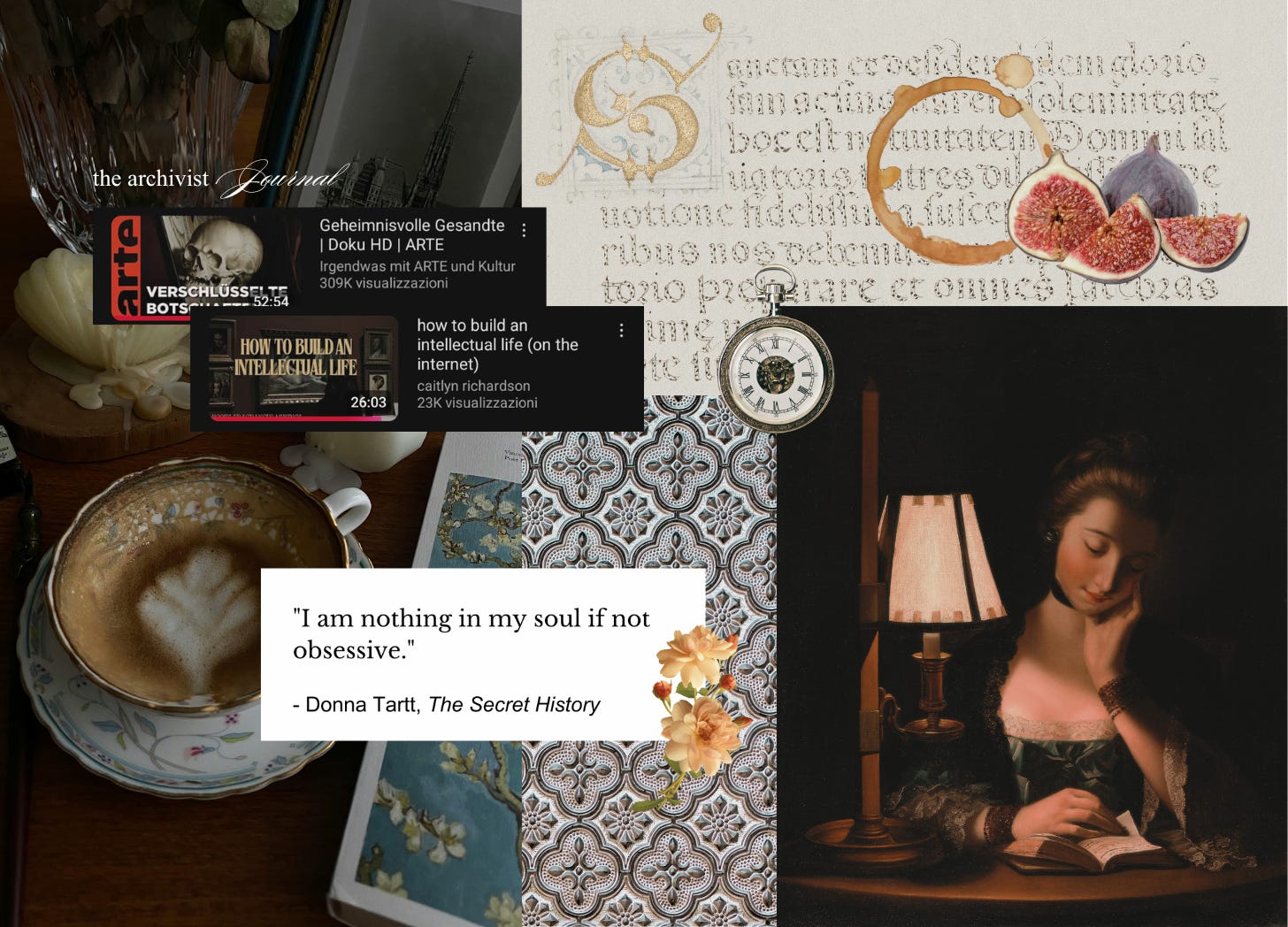
Some days ago, I wrote in my journal: I like myself when I’m hungry, when I don’t have time for the things that don’t matter to me, because I’m spending my days observing the world, reading books, learning things. I am what I fill my life with, and I don’t want to fill it with empty things; I don’t want a life that looks like lacework, because the things I once put there were inconsistent, and looking back all I can see are the gaps left by pieces that decomposed and disappeared from my memory. Is it really sacrifice if it’s fulfilling in the long term?
I believe this basically sums up everything that I’ve been working towards lately. I might write an entire post about new year’s resolutions and how my approach has changed since I first started setting them, but in this piece I want to focus on my self-study plans for 2026. I prefer calling them plans, rather than goals, because I tend to visualise a goal as a result placed far ahead in the future and I overestimate how much I can achieve in just twelve months. A plan feels more structured, more tangible, something I can start working on the first of January. Not that I believe we all should rebrand as the old year comes to an end, but I like the feeling of fresh start and new opportunities that the cold winter wind brings along during this period. My ultimate purpose this year is not to become a completely different person, but get closer to who I truly am.
Like I did for my winter curriculum (which is part of the plan, by the way), I decided to divide my 2026 self-study plan in four sections, each of them having its own goal, reading list/ study plan, and assignments.
Academia
This section is the university-related part of my curriculum. As a master student of archival and library sciences, I’m going to be focusing on deepening my understanding of different topics surrounding these disciplines.
Goal: Read outside my syllabus to further explore topics related to my studies, so that I can bring this knowledge to my lectures and exams.
Study plan: Read an article (or more) a week related to a topic that sparks my curiosity (ideally, I would choose a different one each month).
Assignments: Take notes and write my own “research papers” about these topics. The good ones might be posted on Substack as well.
Some topics I’d like to research
digitisation and preservation of digital documents
the process of appraisal
book trade
the history of knowledge and ideas
the evolution of archival theory
manuscripts and print
the relationship between archives and libraries
private archives
origins and evolution of the document
Language learning
The next section is dedicated to my language learning journey. I’ve been self-studying German for some years on and off, and I wish to study more consistently in 2026.
Goal: Be able to read fluently, improve my pronunciation and expand my vocabulary. Review and strengthen my grammar knowledge.
Study plan: This is probably going to change depending on the season. In general I want to do a little bit of studying everyday. For the next couple of months, I’ll be testing this weekly schedule, which includes assignments as well, and then when I’ll start going to lectures again, I’ll probably adapt it to how much time and energy I have left from schoolwork and commuting.
Monday: explore a topic and make flashcards. I’m flexible with my resources, I can use videos, articles, even Wikipedia if I feel like it.
Tuesday: review my vocabulary flashcards from Monday and do some Grammar exercises.
Wednesday: practice pronunciation with the shadow boxing technique (if you’re not familiar with it, I recommend watching this video, which explains it very well).
Thursday: Grammar exercises (maybe I’ll choose to do nouns, adjectives and pronouns on Tuesday and verbs on Thursday).
Friday: Reading, whatever I feel like, short stories, articles or the news (even better if what I’m reading is related to the topic I’ve chosen on Monday). I also plan on making flashcards from what I’m reading.
Saturday: review of what I’ve done the entire week and writing/ speaking practice, maybe by talking about the topic I’ve chosen on Monday.
Sunday: listening or watching a movie.


Creativity
If you’ve read my Winter curriculum post, you know I’ve been neglecting this one a lot. But lately I’ve learnt I need some balance between learning and creating. My favourite way of channeling my creativity has always been writing and I thought of a seasonal plan to improve my skills.
Goal: To be a writer. Not a published or successful one, but to simply write and read a lot.
Study plan: I thought it would be fun if I focused on a different “genre” each season, so here’s my plan for the next few months:
Winter: personal essays. I’ve posted my reading list in my winter curriculum piece. My assignment is to regularly write and share my own personal essays on Substack, also to hopefully get some feedback on my work.
Spring: fiction. I’ve yet to think of a reading list for this, but I’ll most likely share it when I post my spring curriculum. My assignment would be to write and share some pieces of short fiction here on Substack.
Summer: poetry. Again, the reading list is yet to be defined, but I’ll probably post it in my Summer curriculum. This time, I don’t think I’ll write poems (or maybe I’ll try, but I don’t feel confident enough in this field to share them), but I’ll read them and my plan is to learn how to analyse them and understand them. Poetry has always been an obscure art for me and when studying literature, even in my mother tongue, I’ve always preferred prose. But I’m getting more and more curious about it, especially as a language learner who’s interested in vocabulary and the use of words, so I’ll try getting into it this summer.
Personal library
This section is dedicated to the books I want to read to build a metaphysical personal library in my mind.
Goal: Read a variety of genres, books from every part of the world and in different languages.
Study plan: As for my tbr, I don’t have a yearly one, because I’m a mood reader and tend to read a bit of everything. That being said, I’ve shared my winter tbr in my winter curriculum post and I want to read more nonfiction and poetry this year, as well as expand my geographical horizons when it comes to classical literature.
Assignment: Read actively, annotate and start a conversation with the book. If some topic or the book itself is particularly interesting, research it and write about it.
I hope this inspired you to create your own study plan for 2026. I’d love to know what you want to learn, research and explore, and also how you plan on doing so. If you have any tips on how I can improve my plan, feel free to let me know!
Thanks for reading,
𝒢. 𝒢.
Related posts
Winter curriculum: reading lists, syllabus and rituals

Winter is the season of hibernation, rest and silence. In an ideal world, I sleep from the first of December to the end of February, but that’s obviously not possible. Still, I think a winter personal curriculum should be designed to create comfort and it might have to go beyond my reading list and syllabus; it might have to include activities and ritua…
How I self-study when I'm busy

As a person with multiple interests and as an aspiring archivist, educating myself in different subjects is a form of self-care, as well as a crucial step for my future career. To me, learning has always been a fun experience, and the more I collect tools for my education, the more autonomous I am in it, the mor…
My Instagram


This is a really great and well thought out. I’m doing the same thing myself, curating a plan for each quarter of what I want to be accomplished. Definitely will be taking this as an inspiration.
Such a great curated list. I personally struggle a little with time management. Do you mind telling me how you manage to shuffle all activities at once?