

Thinking in shorthand
Writing to connect and curiosity diaries 11.17.25 - 11.23.25
Every time I open my journal and pick up a pen I don’t know where the ink stains on the page will lead me. Sometimes I don’t even know where to start, but I think every writer, from the bestselling authors, to the ones who fill up notebooks meant to be destroyed or shown only to a few, trusted people, starts by asking questions. Some questions are easy to answer: I know what I have to do today and what tomorrow. However, asking myself how I’m feeling or what am I thinking always throws me off.
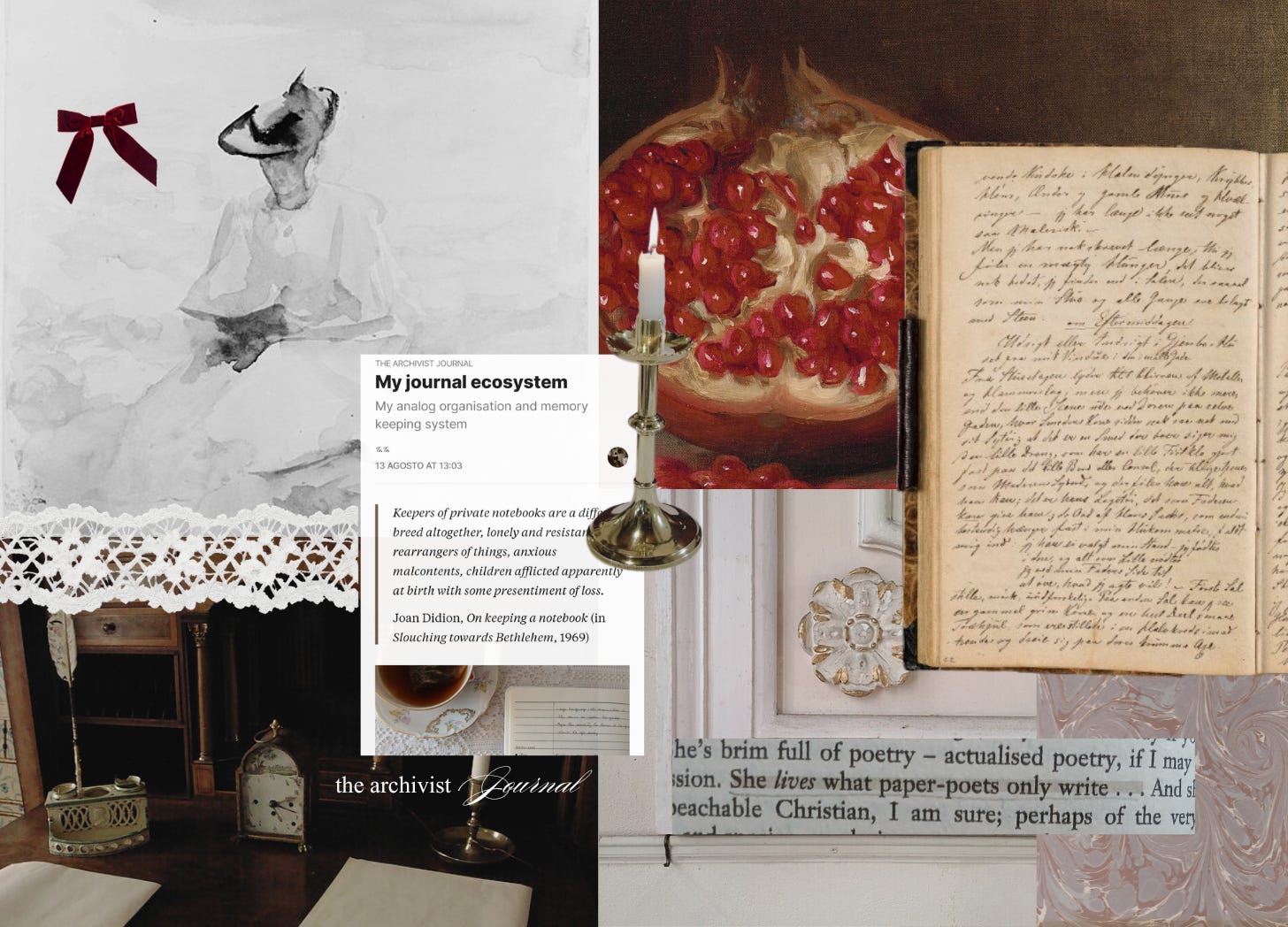
“I write entirely to find out what I’m thinking, what I’m looking at, what I see and what it means.”
Why I write - Joan Didion
Writing is a way to unravel the bundle that tangles up in my mind every time my brain receives an external or internal input. This process of rationalisation and “relativisation” of the world requires a bit of time and a bit of silence. I can’t understand right away why the image of a stranger struggling through the crowd at a train station during rush hour with his yellow suitcase imprints itself on my synapses and comes back to me in a dream. When the stranger meets my gaze, I only see his yellow suitcase, in a peculiar shade of yellow, almost comical for some inexplicable reason. The suitcase is the only thing I remember, but it inspires me to create a character that has nothing to do with the stranger and transfer the silliness of the lemon yellow of his suitcase to his persona. Then I begin writing that I saw a silly man with a yellow suitcase struggling through the overcrowded station. Naturally, the man wasn’t silly and neither the suitcase, but the scene starts resembling a comedy, because my brain was hit simultaneously by an external impulse (the man with the suitcase) and an internal one (how I was feeling).
How do I feel? seems a question exclusively projected inward, like I should find a way to dig into my soul and read the answer engraved in a corner of my psyche. Some people easily overcome this metaphorical challenge, but for me it’s difficult: I need a physical reference to attach myself to while I descend the abyss of my consciousness, otherwise I’m not able to climb down without fear. And I can’t be scared if I want to know something new: curiosity and fear are polar opposites. But I don’t need to isolate in a desert to get to know myself, because the world I live in is my projection. I don’t mean that I should let myself spiral into an existential crisis and convince myself that my life is just a dream, or a story in which I intentionally create the setting and characters, which wouldn’t even be respectful towards everyone who takes part in it, like the stranger with the yellow suitcase. I haven’t of course invented him or any other person that crowds the train station.
What I want to say is that the version of the stranger that got stuck in my head is my projection and has little or nothing to do with the stranger himself. My inner world overlapped the exterior one, it altered its image revealing to me details which I couldn’t have discovered if I had decided to retreat in the tangle of my thoughts and never again open my eyes. Writing helps me understand which details of the original image got distorted by what I was feeling, and eventually what I was actually feeling.
* The title of this post was inspired by this quote:
“When I say that I was wondering if the lights were on in the bevatron you might immediately suspect, if you deal in ideas at all, that I was registering the bevatron as a political symbol, thinking in shorthand about the military industrial complex and its role in the university community, but you would be wrong. I was only wondering if the lights were on in the bevatron, and how they looked. A physical fact.”
Why I write - Joan Didion
Curiosity diaries 11.17.25 - 11.23.25
Here’s a list of media I consumed this week:
Articles
“I awoke at 1/2 past 7” - Elena Mary
The transformation of the diary from a self-reflection space to a self-optimisation tool in the victorian period.
“Why I write” - Joan Didion
An essay describing the author’s writing and self-discovery process.
“The power of good literature, the limits of self-help books” - chicgirlmoment
An essay on how literary fiction can help people question themselves and thus improve their lives more than self-help books.
YouTube videos
Watch me beat creative burnout - Angel Zheng
A vlog showing different ways to recover creativity.
A writing practice to help you meet yourself - Anna Howard
I loved this! A video essay explainining the benefits of writing for self-reflection.
Journaling rituals. Writing to taste life twice - earthlingzee
A cosy and comforting journaling vlog with tips and ideas to develop a consitent journaling practice.
Films and documentaries
“An officer and a spy” (J’accuse), 2019
Based on the Dreyfus affair, the false accusation of treason against the French army captain Alfred Dreyfus in 1894. The original title refers to the article “J’accuse...!” wrote by Émile Zola, in which the novelist openly claimed that many people in the army and the government supported Dreyfus’ unjust imprisonment to cover their incompetence while leading the investigations. The affair takes place in a delicate period of french and european history in general, while cospiracy theories against jews and antisemitimism were quickly spreading across the continent.


(original in Italian)
Pensare in corsivo: scrivere per capire
Ogni volta che apro il mio diario e prendo in mano la penna non ho idea di dove le macchie di inchiostro vogliano condurmi. A volte non so neanche da dove iniziare, ma immagino che tutti gli scrittori, dagli autori di bestsellers, a quelli che riempiono quaderni destinati a essere distrutti o mostrati solo a poche persone di fiducia, inizino col farsi delle domande. Ad alcune domande è relativamente facile rispondere: so cosa ho fatto oggi e cosa dovró fare domani. Tuttavia, se mi chiedo come mi sento o a cosa sto pensando vado in confusione.
“Scrivo esclusivamente per capire a cosa sto pensando, cosa sto guardando e cosa significa.”
Why I write - Joan Didion
Scrivere è un modo per districare il groviglio che si intreccia nella mia mente ogni volta che il mio cervello riceve un impulso dall’esterno o dall’interno. Il processo di razionalizzazione e “relativizzazione” del mondo richiede un po’ di tempo e anche un po’ di quiete. Non si può sapere subito perché l’immagine di uno sconosciuto che si fa strada in mezzo alla folla in una stazione all’ora di punta con la sua valigia gialla si imprima sulle sinapsi e si ripresenti, magari, in un sogno. Nel momento in cui lo sconosciuto mi passa davanti agli occhi, non vedo altro che la sua valigia gialla, una sfumatura particolare di giallo, quasi comica, per qualche inspiegabile motivo. La valigia è l’unica cosa che mi ricordo, ma diventa uno spunto per creare un personaggio che non ha niente a che fare con lo sconosciuto e trasferire la comicità del giallo limone del suo bagaglio in una caratteristica della sua natura. Allora inizio a scrivere che ho visto un uomo buffo con una valigia gialla che faticava ad attraversare la stazione gremita di gente. Ovviamente l’uomo non era buffo e neanche la valigia, ma la scena assume i connotati di una commedia perché il mio cervello era contemporaneamente colpito da un impulso esterno (l’uomo con la valigia) e un impulso interno (come mi sentivo).
Come mi sento? sembra una domanda proiettata esclusivamente all’interno, come se dovessi trovare il modo di scavare nella mia anima e leggere la risposta incisa in un angolino della mia psiche. Ci sono persone che riescono in quest’impresa metaforica senza troppi problemi, ma per me è difficile: ho bisogno di un appiglio fisico a cui agganciarmi mentre discendo l’abisso della mia coscienza, altrimenti non sono in grado di calarmi senza avere paura. E non si può avere paura se si vuole conoscere qualcosa di nuovo: curiosità e paura sono agli antipodi. Ma non ho bisogno di ritirarmi su un eremo per conoscere me stessa, perché il mondo in cui vivo è una mia proiezione. Con questo non intendo abbandonarmi ad una crisi esistenziale e convincermi che la mia vita è solo un sogno, una storia di cui creo a tavolino ambientazione e personaggi, cosa che non sarebbe neanche rispettosa nei confronti delle persone che partecipano della mia esperienza di vita, come lo sconosciuto con la valigia gialla. Anche lui, come tutti gli altri che affollano la stazione, non l’ho certo inventato io.
Ciò che intendo dire è che l’immagine che mi si è impressa nella mente di quello sconosciuto è una mia proiezione e ha poco o nulla a che fare con lo sconosciuto stesso. Il mio mondo interiore si è sovrapposto a quello esteriore, alterandone l’aspetto e rivelandomi dettagli che non avrei mai potuto scoprire se avessi deciso di ritirarmi nel ginepraio dei miei pensieri e non aprire più gli occhi. Scrivere mi aiuta a capire quali dettagli dell’immagine originale sono stati trasformati da ciò che sentivo e dunque capire cosa era esattamente ciò che sentivo.
Thanks for reading,
𝒢. 𝒢.
Related posts
My journal ecosystem

Keepers of private notebooks are a different breed altogether, lonely and resistant rearrangers of things, anxious malcontents, children afflicted apparently at birth with some presentiment of loss.
In search of lost coherence

But within ourselves, in what we call soul, which is the life inside of us, the flow keeps streaming, unclear, under the banks, beyond the limits that we set by assembling a conscience and building a personality.
My Instagram


loved every second i spent reading this!
this is so gorgeous