

January digest
The Archivist Journal's monthly collection of musings, books, media pieces and self-study updates
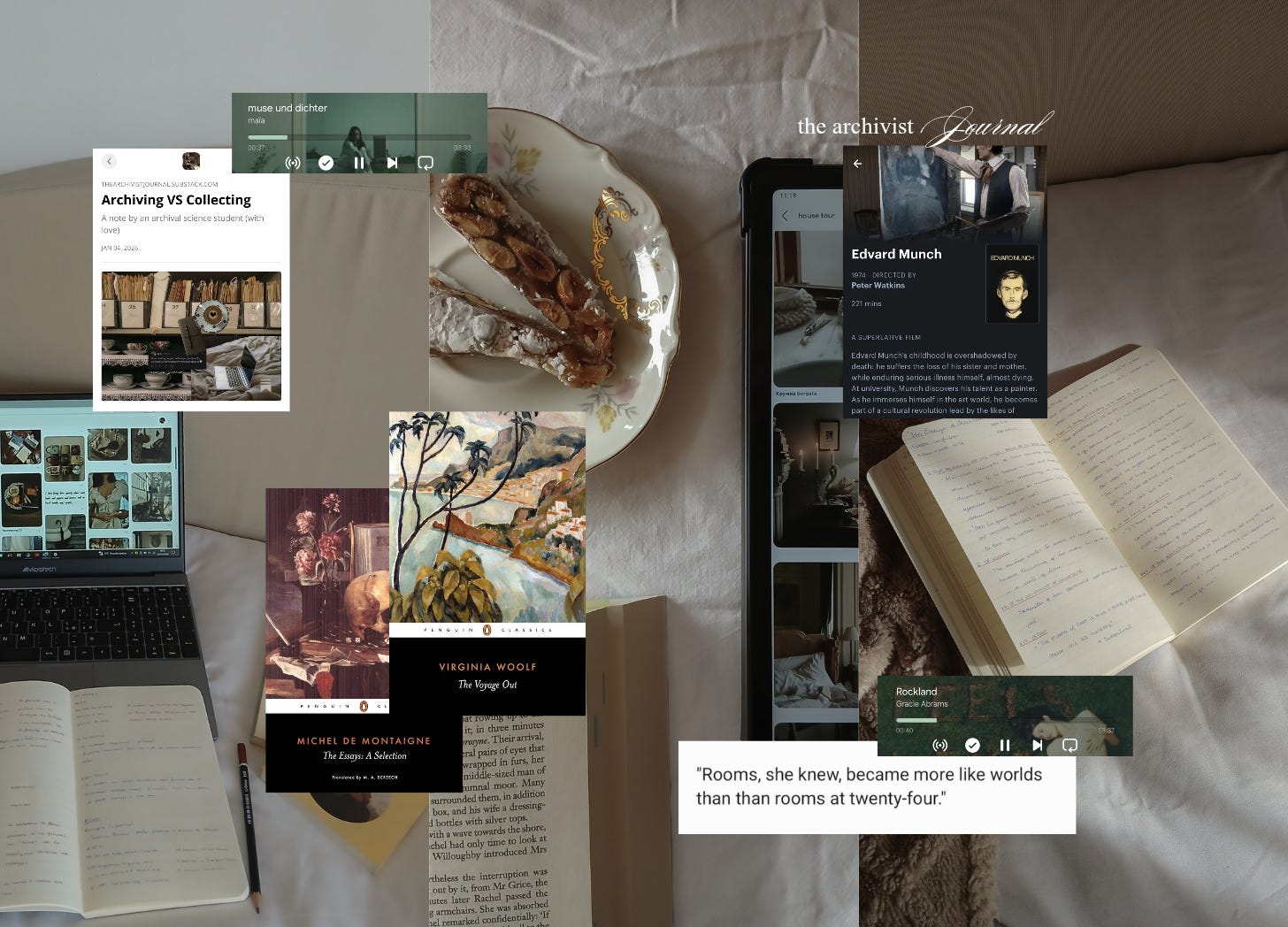
Cold and rainy January was an inspiring start to my year. I’ve been busy studying for my exams, so I didn’t read as much as I wanted to and I fell off my winter curriculum plans. But I’m discovering a different way of self-learning, less structured and more “intuitive”. I don’t think I’ll do another post about my personal curriculum, unless I really feel the need to plan everything out, because I’m noticing I learn better by following my curiosity and I’m also able to maintain consistency for longer periods of time. I’m going to update about my goals and self-study routines in my monthly digests. I’m thinking of making this a series where I collect my book reviews, films and documentaries I watched, and my highlights from my weekly digital gardens. I hope in February I’ll be able to slow down a bit more and take some more time for writing, because I have a lot of ideas for upcoming essays, and I’m very excited for the one I’m posting next Sunday.
The Reading List
My reviews of all the books I’ve read this month
Virginia Woolf, The Voyage Out (1915)
“I desire the company of a man who could sympathize with me, whose eyes would reply to mine” writes Rober Walton in Mary Shelley’s “Frankestein”. Rachel, the protagonist of “The Voyage Out” seems to look for the same feeling, once she steps out of her father’s shelter and travels with her uncles across the ocean.
Since the beginning of the novel, I’ve asked myself where “The Voyage Out” was going lead me. First, the story reaches the shores of the new continent, then Rachel gets out of her shell. She meets a lot of people in the small village where she’s staying, english travellers that look akward in the wild forests of south America. A man, Terence Hewet, makes Rachel fall in love for the first time, experiencing herself out of herself. So, Rachel takes the leap to become a woman.
But as E. Dempsey (2007) points out, Rachel can’t become a woman just to be owned by another man. So the author acts as a deus ex machina in this novel, setting Rachel free again right before she would’ve been caged. She exits the scene at the end making her last voyage out, out of the conventions of life and gender roles. She reminds me of another character created by Woolf’s brilliant imagination, Mary Datchet, the activist for women’s right to vote in “Night and Day”. Feminism is, in a sense, a fil rouge that connects this novel to her debut and to her essay “A Room of One’s Own”.
I don’t think there’s a single work by Virginia Woolf that I haven’t liked so far, but this one resonated with me very deeply, probably because Rachel and I have a lot of things in common: we’re close in age and have been always trying to find real connection to others, but we’re probably both destined for freedom in different ways.


Digital Garden
A selection of the best articles, videos, films and documentaries of the month
Articles
When story loses the plot: how story-telling has changed in contemporary times and plot has lost its importance in favour of character and emotional development.
The lost art of thinking historically: On the importance of contextualising and thinking critically of the past in a world that tends to oversimplify or sensationalise history.
Ten writing prompts: Writing prompts to improve creative thinking. I especially liked the "Distraction Diary" idea.
how to live a life worth writing about: How to take inspiration from the mundane to write.
The Shape of Time: How philosphers theorised time as a line and how that lead to today's view of time and speculations on it, such as time travel.
Videos
Edward Said on Culture and Imperialism at York University (1993): A lecture by Edward Said (the author of "Orientalism") at the York University, discussing imperialism, colonialism and their cultural basis.
How To Find Inner Clarity To Return Back To Yourself: A video essay on overthinking and being present.
Films
The Hourglass Sanatorium (1973): A dreamlike, kafkesque journey of a man into his childhood, grief and relationships.
Morgiana (1972): A gothic, thrilling story about a woman’s jealousy and obsession, which lead her to murder. Costumes and make-up were extremely gorgeous.
Edvard Munch (1974): A film-documentary on the life and art of the norwegian painter Edvard Munch, connecting his painful experiences to his works.


In Case You Missed It
What I posted this month
Poetry before dinner

Lately I’ve been making it a ritual to read poetry before dinner. I sit at my desk with my lamp on and maybe some tea, my reading journal, and I go through the collection I’ve picked up. I’ve been an avid reader since childhood but poetry scares me. I remember taking classes on Dante and Petrarca, Foscolo and Leopardi in highschool, when the teacher wou…
A week of learning

Today I'm just sharing the links to this week's digital garden, because I've been extremely busy lately (currently studying for my exams until February) and today is my birthday, so I'd like to stay off social media as much as possible. Still, I had a very interesting week in terms of learning and media consumption.
The internet atelier

Being born and growing up in the digital era is probably the primary cause of my incurable doomscrolling habits, but not entirely. Algorithms exist for a reason and that is to keep people hooked, always wanting to consume another piece of short-form content they won’t remember, always wanting to comment on …
Archiving VS Collecting

I keep seeing posts on here titled “media archives”, “last month’s archive” and so on, which collect media pieces, ideas and recommendations. I love reading them and I find that I always discover something interesting in them, but my archival science student brain is always triggered by the use of the word “archive” in the title of these types of pieces.
Field Notes
My self-study updates and resources
Academia (everything related to my field of study)
I didn’t do a lot of research this month, because I spent most of my time studying for my exams. However I picked up SQL again and decided to review what I’ve learnt this summer using this app.
Language Learning
This month I’ve worked on my German learning mostly using the free resources on the DW Deutsch Lernen website, especially the Top-Thema mit Vokabeln and the Video Thema sections.
Creativity
As I said at the beginning of the post, I’ve been getting a lot of ideas for my writing this month, but I really couldn’t find time to slow down and be creative. I’ve been very consistent with journaling however, I’ve also started posting journaling guides on Substack notes.


On Repeat
Top songs from my monthly playlist
Thanks for reading,
𝒢. 𝒢.
Jan. 2-9 2026 | digital garden
Media I recommend this week
Articles and videos
how to live a life worth writing about: How to take inspiration from the mundane to write.
The Shape of Time: How philosphers theorised time as a line and how that lead to today’s view of time and speculations on it, such as time travel.
How To Find Inner Clarity To Return Back To Yourself: A video essay on overthinking and being present.
i still believe in magic: A touching piece on magic, faith and connection.
The Work Behind the Writing: On Writers and Their Day Jobs: Writing with a full time job, and writing as labour and a privilege.
Films and documentaries
Edvard Munch (1974): A film-documentary on the life and art of the norwegian painter Edvard Munch, connecting his painful experiences to his works.