

Archiving VS Collecting
A note by an archival science student (with love)
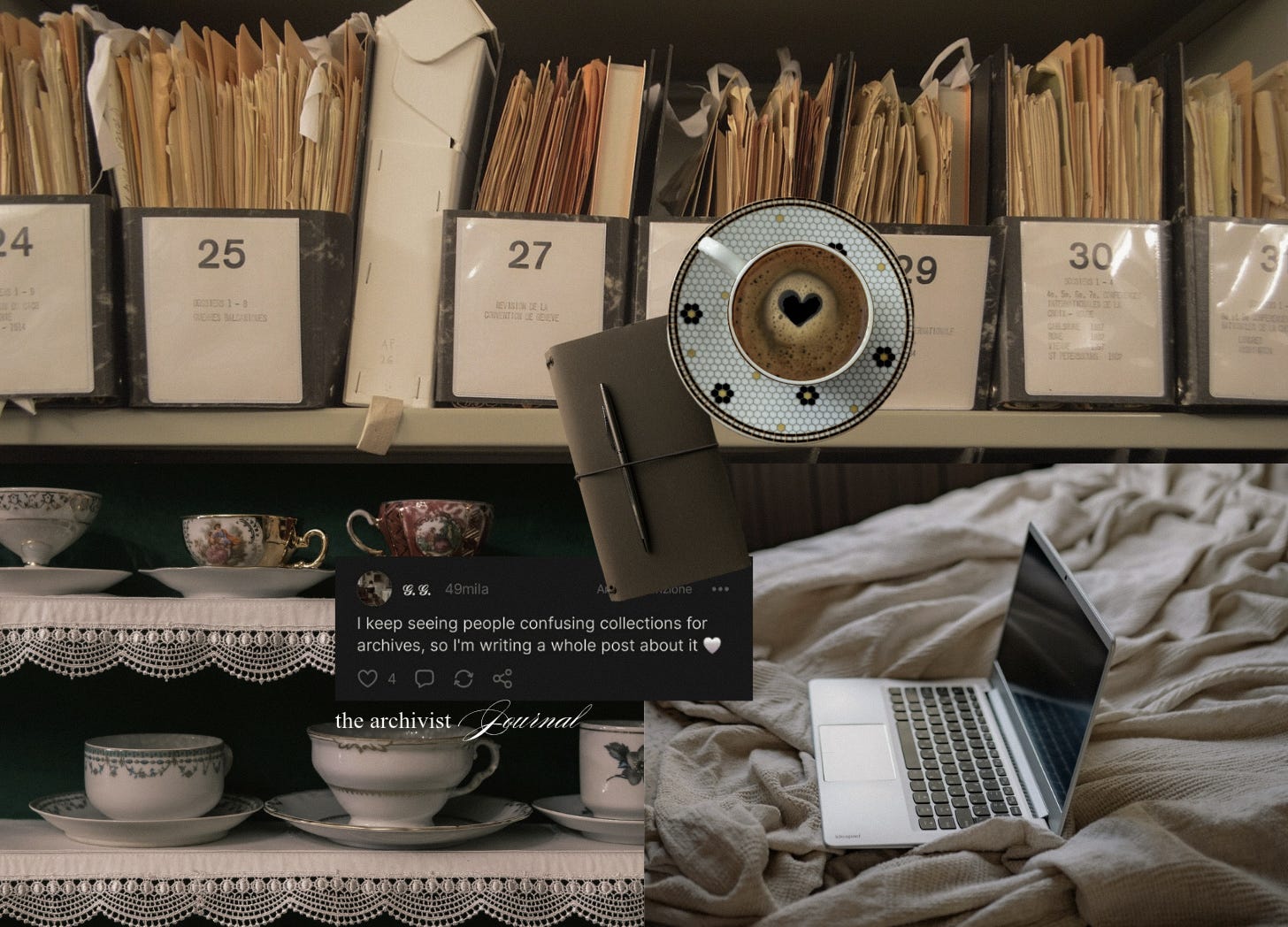
I keep seeing posts on here titled “media archives”, “last month’s archive” and so on, which collect media pieces, ideas and recommendations. I love reading them and I find that I always discover something interesting in them, but my archival science student brain is always triggered by the use of the word “archive” in the title of these types of pieces.
I completely understand where the confusion between archives and collections comes from. The Cambridge online dictionary states that an archive is “a collection of historical records relating to a place, organisation, or a family1”; even Wikipedia writes that “archival science seeks to improve methods for appraising, storing, preserving, and processing (arranging and describing) collections of materials2”. I can picture my archival theory professor having a heart attack while reading this, and I feel like fainting too.
Let’s analyse the Cambridge dictionary definition. Aside from being incorrect, it also claims that the only “collections” worth of being called archives are the ones which contain historical documentation. Depending on where you live in the world, the archival practice may vary, but generally archival records go through at least three phases, which in english are called:
current records: the phase when the documents are actually produced and stored for use;
semi-current/ intermediate records: the phase in which archivists organise the records and perform the operation of appraisal;
historical/ permanent records: the phase referred to by the Cambridge dictionary, the last one, where only records of particular historical and cultural interest are forever preserved.
These phases already distinguish a collection from an archive, but let’s get to the heart of the matter. I study in Italy and one of the first definitions of archive I’ve encountered in my career is the one of Giorgio Cencetti, an italian archivist, who wrote in 1937:
The archive is the complex of documents sent and received by an institution or person for the achievement of their goals or for the exertion of their functions.3
Notice how Cencetti’s definition doesn’t use the word “collection”, not even in italian.
So where does this confusion come from historically?
In order to find out, we need to go back to the second half of the XVIII century, and move from Italy to France, where Denis Diderot and Jean Baptiste d’Alembert published the first encyclopédie. Aside from being revolutionary for scientific and even humanities studies, the encyclopédie transforms the methods of organising archives in Europe. The perfect division by subject of the contents in the first encyclopaedia is slowly emulated in archives, especially the private ones, usually kept and organised by librarians, who are already used to this storing method for books’ collections.
The results of this organisation by subject can be seen even today, with entire sections of the historical archive of Milan almost inaccessible, because the order of the documents doesn’t make sense anymore4.


So, what is wrong with storing archival records by subject?
Picture a vast archive, maybe a public one, storing documents from different periods of time, coming from different territorial divisions, produced by different institutions (the king, the parliament, the president etc.) organised by subject (roadworks, taxes, agriculture) and not in chronological order.
What we’re really looking for most times, as archivists or as historians, are not the documents themselves but their relations to each other, the “archival bond”. We’re looking for documents who are related in chronological order (historical method), coming from a specific territorial district, all produced by a single institution (principle of provenance) and we’re looking for it in one archive that we can trust, because it’s always been kept in the same place and not transported back and forth, with the risk of losing records everywhere (continuous custody).
All of these characteristics ensure the survival of the archival bond, the main element that differentiates a collection, organised by subject (as here on substack with media collections divided in categories like “films”, “articles”, “books”, etc.) and an archive, which can’t be organised by subject, otherwise the relations between documents are destroyed and it becomes a collection.
Again, this post is not intended as an attack to everyone who uses the word “archive” as a synonym for “collection”, which is not an improper use outside of the archival science studies. But I hope I have given my contribution and inspired you with something educational about a topic we don’t often think about.
Thanks for reading,
𝒢. 𝒢.
*This information comes mostly from lectures I attended in university, so I don’t have a lot of sources to cite. This post is not intended to be an academic paper or essay, just an overview on the subject. I wrote a piece with more references on the definition of archive, which is linked below.
Related posts
A glimpse into archives

In order to transcend the limits of time, space, and the fragile nature of human memory, societies depend on archives.
My self-study plans for 2026

Some days ago, I wrote in my journal: I like myself when I’m hungry, when I don’t have time for the things that don’t matter to me, because I’m spending my days observing the world, reading books, learning things. I am what I fill my life with, and I don’t want to fill it with empty things; I don’t want a life that looks like lacework, because the thing…
My Instagram
Pictures credits
First-ICRC-records ICRC-Archives RomanDeckert09062020.jpg, Gül Işık, Yan Krukau, Tuğba Özgen

Cencetti G. (1937), Sull’archivio come Universitas rerum, Roma.
It was really interesting, thank you for sharing your science with us. There is a school here in France called École des chartes which is a school of archives and I know they are studying ways of archiving written and numerical datas and work with public institutions and ministries. I read the definition by Giorgio Cencetti and it occurs how political archiving. You follow a classification system (or you choose one), this classification can change over time and space (that's what we understand if we follow this Diderot's story), you respond to institutional demands : all of this is deeply a work of bias. I wonder how you consider this political aspect in your (future) work.
This is so interesting. Archival science was probably that last thing on my radar, but now it’s got me thinking about the complexities of it all. I think before now I would have just said both archive and collection was interchangeable. Never thought there was a full process that goes into it.